
MOTORBIKE TOUR ON HO CHI MINH TRAIL
About Ho Chi Minh Trail
The legendary Ho Chi Minh Trail was a vast network of supply routes used by North Vietnam to connect the north and south during the Vietnam War, known locally as the American War. Soldiers, ammunition, weapons, food, fuel, and other supplies were transported by foot, bicycle, and truck for hundreds of kilometres through the dense and difficult jungle along Vietnam’s mountainous border with Laos.
The Trail became a remarkable example of the determination, ingenuity, and endurance of the Vietnamese people. After the war ended, many sections of the original route gradually disappeared back into the jungle. In more recent years, however, new roads have been built along or near parts of the historic Trail, making it possible for adventurous travellers to explore this extraordinary region by motorcycle.
Our Ho Chi Minh Trail motorbike tour combines fascinating history with some of the best riding and scenery in Central Vietnam. The route takes in the former imperial capital of Hue, the ancient trading town of Hoi An, the historic Khe Sanh battlefield, the remote and infamous A Shau Valley, Non Nuoc Beach, Vietnam War museums and memorials, and the former Demilitarized Zone (DMZ).
We also spend a night in a traditional Thai ethnic village, allowing you to experience local hospitality and rural life. In Hue, we visit some of the impressive Imperial Tombs, adding another important chapter of Vietnamese history to the journey.
This is a unique opportunity to ride through landscapes connected to one of the most important periods in modern Vietnamese history. The tour is designed as a moderate-level motorcycle adventure and is best suited to bikers and experienced riders who are comfortable spending several hours on a motorcycle each day.
To get an idea of what our Ho Chi Minh Trail motorbike tours are like, please watch the video below.
If you would like to watch more riding videos from our Vietnam motorcycle adventures, please check our YouTube channel.
DETAILED ITINERARY
Day 1: Hanoi – Mai Chau (~160 km, ~6 h)
We leave Hanoi and head west along Highway 6 toward Mai Chau, a beautiful mountain valley inhabited mainly by the White Thai ethnic community. Mai Chau is surrounded by spectacular limestone mountains, green rice fields, and traditional villages, making it an excellent first destination for our Ho Chi Minh Trail motorbike adventure.
During our journey from Hanoi, we also have opportunities to observe the traditional agricultural landscapes of the Red River Delta and the Da River valley, where rice cultivation has shaped local life for generations. As we move farther into the mountains, the scenery changes dramatically, with limestone peaks and colorful ethnic villages appearing along the route.
After lunch, we have the afternoon to explore the area around Thung Nhuoi Pass. We can ride and climb toward the top of the pass, where spectacular views open across the Mai Chau Valley. The valley is often covered by low clouds or mist, creating an atmospheric mountain landscape that is especially beautiful from above.
After enjoying the viewpoint, we descend into the valley and continue exploring the villages and countryside of the White Thai people.
In the evening, we enjoy a traditional local dinner and stay overnight in a beautiful village beside the river. After dinner, we can gather around a fire and enjoy a traditional Thai music and dance performance.
Dressed in their traditional costumes, local Thai women may invite visitors to join the Xoe dance, a traditional communal dance performed to lively music. Hosts and guests join hands and dance together, creating a warm and friendly atmosphere.
When everyone needs a break, we can relax and enjoy ruou can, a traditional Vietnamese rice wine shared from a communal jar. Taking part in a traditional Xoe dance around a village fire is a memorable way to begin our journey through Northern and Central Vietnam.

Day 2: Mai Chau (~100 km, ~3 h)
Today is a relatively easy riding day, giving us time to relax and prepare for the more challenging sections of the Ho Chi Minh Trail motorbike adventure ahead.
In the morning, we explore the mountains to the north of Mai Chau, riding through beautiful countryside and visiting remote communities of the H’mong and Dao ethnic groups. Many families in these mountain areas have maintained traditional ways of life for generations, making this an excellent opportunity to experience a quieter and more authentic side of Northern Vietnam.
In the evening, we can enjoy another traditional Thai music and dance performance, providing a chance to relax and experience more of the local culture.
Alternatively, we can ride toward Bai Sang to explore the old and largely forgotten sections of Highway 6. From there, we can take a boat trip to explore part of the enormous reservoir created by the Hoa Binh Hydroelectric Dam, one of the largest reservoirs in Northern Vietnam.
We spend another night in a traditional Thai stilt house in Poom Coong Village, Mai Chau.
Day 3: Mai Chau – Vinh (~280 km, ~8 h)
We leave Mai Chau and head south along a beautiful winding mountain road following the Ma River. The route takes us through increasingly remote countryside before joining the modern Ho Chi Minh Highway.
This section of the highway follows the general direction of the historic Ho Chi Minh Trail and takes us deep into the remote backcountry of Central Vietnam, not far from the Laos border. The further south we travel, the more isolated the landscape becomes, with mountains, forests, small villages, and quiet roads providing a fascinating contrast to the busier parts of Vietnam.
After a long day of riding, we turn east toward the coast and continue to Vinh, the largest city in the north-central region. Vinh is also historically significant as the area where Ho Chi Minh was born, making it an interesting stop on a journey following the history of the Ho Chi Minh Trail.
We spend the night in Vinh.
Day 4: Vinh – Dong Hoi (~230 km, ~7 h)
We leave Vinh and ride south along Highway 1 before turning inland toward the mountainous region close to the Laos border. Along the way, we pass the Dong Loc Junction, an important wartime crossroads that played a major role in the transportation and supply network feeding the Ho Chi Minh Trail. In Vietnam, the area is widely regarded as one of the important starting points of the Trail.
From Dong Loc, we continue through remote backcountry where the scenery gradually changes. The mountains become increasingly rugged, and spectacular limestone karst formations begin to dominate the landscape.
We then reach two historically important crossroads that once carried a significant amount of traffic from the Ho Chi Minh Trail toward Laos. During the war, these routes were heavily used to move soldiers and supplies through some of the most difficult terrain in the region.
In the afternoon, we arrive at Phong Nha-Ke Bang, a spectacular UNESCO World Heritage Site famous for its enormous limestone mountains and extensive cave systems. During the Vietnam War, the caves and surrounding mountains provided shelter for local civilians and military personnel from the intense bombing.
After exploring the Phong Nha area, we continue toward the coast and reach Dong Hoi, which was heavily bombarded during the war, including attacks from U.S. naval forces.
We check into a hotel overlooking the beach, where we can relax, enjoy the sea, and recover after another long day on the motorcycles.
Overnight in Dong Hoi.
Day 5: Dong Hoi – Khe Sanh (~150 km, ~5 h)
We leave Dong Hoi and head south through the foothills toward the former Demilitarized Zone (DMZ). Much of this region was heavily affected by the Vietnam War, including areas where Agent Orange and other defoliants were used to remove jungle cover along important military routes.
Even today, evidence of the wartime destruction can still be seen across parts of the countryside and mountainsides. As we ride deeper into the former DMZ, we occasionally encounter remnants of the original Ho Chi Minh Trail, providing a tangible connection with the history of the route.
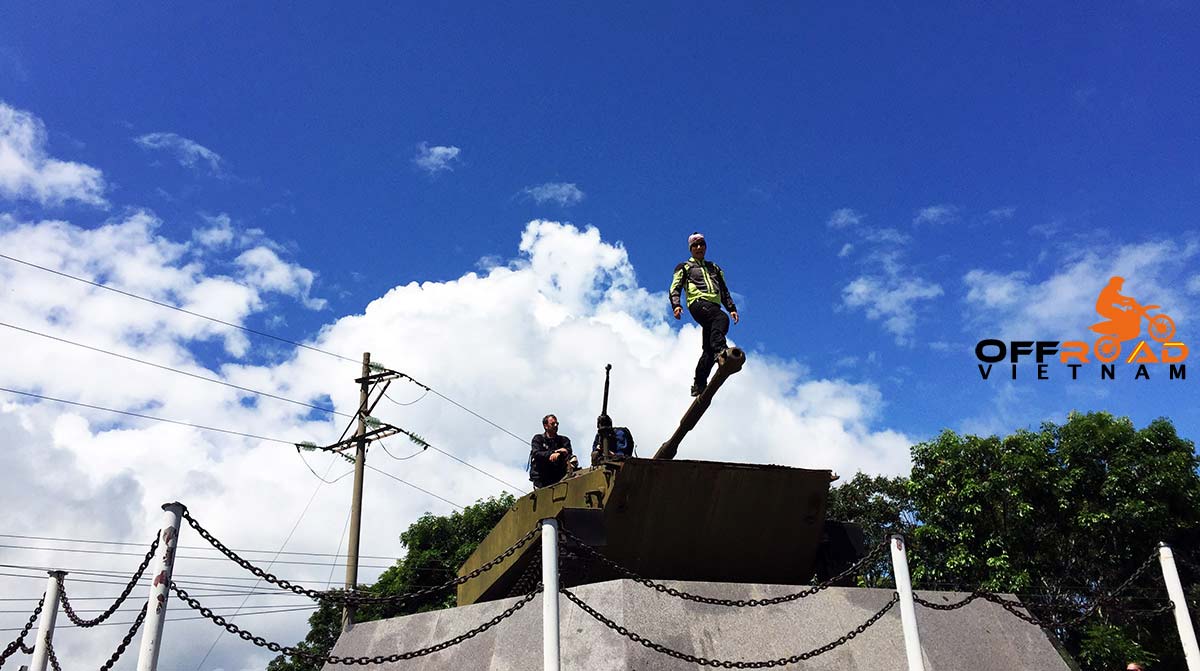
Along the way, we visit several important Vietnam War historical sites, including Hien Luong Bridge, which once stood on the former demarcation line between North and South Vietnam; Khe Sanh, the site of the former U.S. Marine base; Lang Vay, a former U.S. Special Forces base; and the Truong Son Cemetery, a major memorial to Vietnamese soldiers who died along the Ho Chi Minh Trail.
After exploring these historic locations, we continue toward Khe Sanh, where we spend the night.
Day 6: Khe Sanh – Hue (~170 km, ~6 h)
In the morning, we leave Khe Sanh and head south across the Da Krong Bridge, which was built with Cuban assistance in 1973. From here, we enter the infamous A Shau Valley, one of the most heavily contested areas along the former Ho Chi Minh Trail during the Vietnam War.
We ride past the area of Hamburger Hill, made famous by the Battle of Hill 937, and through mountainsides that still show the long-term effects of Agent Orange and wartime defoliation. We eventually reach A Luoi, an area inhabited by many Bru Van Kieu people, one of the ethnic groups of Central Vietnam.
From A Luoi, we leave the main route and cruise through the lush green backcountry, following winding mountain roads and descending the steep Me Oi Pass. This scenic section of the ride takes us through remote valleys, forested mountains, and traditional villages before we continue toward Hue, the former imperial capital of Vietnam.
Hue lies along the banks of the beautiful Perfume River and is one of the country’s most important historical and cultural destinations.
Overnight in Hue.
Day 7: Hue (boating and walking)
There is no riding today, giving us time to relax and explore the former capital city of Vietnam. It is also a perfect opportunity to recover after several demanding days on the motorcycle before we prepare to retrace part of the famous Top Gear Vietnam Special route.
Hue was the imperial capital of feudal Vietnam for more than a century and remains one of the country’s most fascinating historical cities. Today, we can take a relaxing boat ride along the Perfume River, enjoying views of the ancient city and its surrounding countryside.
Depending on your interests, we can visit Thien Mu Pagoda, Minh Mang Tomb, Tu Duc Tomb, and other important imperial monuments. Alternatively, we can explore the remains of the Imperial Citadel, the heart of the former Nguyen Dynasty capital. Much of the citadel was severely damaged during the Tet Offensive in 1968, although many important structures and sections have survived and been restored.
This relaxing day in Hue provides a welcome break from riding while allowing us to discover some of the most important Vietnamese historical and cultural attractions.
Overnight in Hue.
Day 8: Hue – Hoi An (~280km, ~8 h)
We leave Hue and head back toward the mountains, riding over the Me Oi Pass to A Luoi, where we rejoin the route of the Ho Chi Minh Trail. Along the way, we pass through remote areas where many Ta Oi and Co Tu people live and work, often tending their fields beside the road.
From A Luoi, we continue toward the Laos border, riding along the side of a large mountain covered in thick jungle. This remote section offers some of the most spectacular scenery of the journey, with dense forests, steep mountains, and very few signs of modern development.
At the remote town of Hien, we leave the main trail and descend through the Ba Na mountain range. The road gradually takes us toward the coast and the historic trading centre of Hoi An.
Hoi An was one of the most important trading ports in Southeast Asia during the 16th and 17th centuries. Today, its well-preserved old town, traditional architecture, and multicultural heritage have made it a UNESCO World Heritage Site and one of the most atmospheric destinations in Vietnam.
Overnight in Hoi An.

Day 9: Hoi An (relax)
Today is a free day in Hoi An, giving you time to relax and enjoy this historic town after several days of riding through the mountains. If you would like to ride, we can take a short trip to Non Nuoc Beach, where U.S. Marines first landed in Vietnam in 1965.
Alternatively, you can explore Hoi An Ancient Town on foot or by bicycle. There is plenty to keep you busy, from excellent dining and famous Hoi An specialties to impressive historic architecture, traditional tailor shops, and endless opportunities for shopping.
You can also relax on the beach, wander through the narrow streets of the old town, visit local markets, or simply enjoy the atmosphere of one of Vietnam’s most charming destinations. With its combination of history, culture, food, shopping, and beaches, Hoi An is an ideal place to take a break during our Ho Chi Minh Trail motorbike tour.
Overnight in Hoi An.
Day 10: Hoi An – Kon Tum (~290 km, ~9 h)
Today we leave the coast and head back into the mountains, returning to the remote landscapes of the Central Highlands. We eventually rejoin the historic Ho Chi Minh Trail at Phuoc Son, also known as Kham Duc.
Kham Duc has a rugged, frontier-town atmosphere and is sometimes described as a cowboy town of Vietnam. From here, we climb toward the spectacular Lo Xo Pass, following winding mountain roads through increasingly remote countryside.
The route takes us through areas that are sparsely populated by Ba Na ethnic communities, offering opportunities to see traditional villages, farms, and everyday rural life far from Vietnam’s major tourist destinations.
As we continue south, we ride close to the Laos border, where several branches and supply routes of the historic Ho Chi Minh Trail crossed into Laos during the Vietnam War. The combination of remote mountain scenery, ethnic cultures, and wartime history makes this one of the most memorable sections of our Central Vietnam motorcycle adventure.
We eventually descend toward Kon Tum, where we spend the night.
Overnight in Kon Tum.
Day 11: Kon Tum – Buon Ma Thuot (~240 km, ~8 h)
In the morning, we continue south through the spectacular Central Highlands of Vietnam, following mountain roads through forests, plantations, and remote countryside. We pass through Pleiku before continuing toward the historic Ia Drang Valley, the site of one of the best-known battles of the Vietnam War.
The Battle of Ia Drang in 1965 was one of the first major engagements between U.S. and North Vietnamese forces. The valley and surrounding mountains became an important battlefield during the early stages of the conflict, adding another significant historical dimension to today’s ride.
From Ia Drang, we continue toward Buon Ma Thuot, also known as Buon Me Thuot, the largest city in Vietnam’s Central Highlands. The city played an important role in the final stages of the Vietnam War, when North Vietnamese forces launched their decisive campaign in 1975.
Buon Ma Thuot is also famous for producing some of the country’s finest Vietnamese coffee. The surrounding highlands are one of Vietnam’s major coffee-growing regions, making the city an excellent place to enjoy locally produced coffee after a long day on the motorcycle.
Overnight in Buon Ma Thuot.

Day 12: Buon Ma Thuot – Nha Trang (~190 km, ~7 h)
Today we leave the Central Highlands behind and make an easier descent from the Tay Son highlands toward the coast. After several days of riding through remote mountain regions, this change of scenery gives us a more relaxed day on the motorcycle.
We eventually reach Highway 1, approximately 30 km north of Nha Trang, and turn toward the coast. From here, we follow a scenic coastal stretch with turquoise waters, sandy beaches, and colourful fishing boats scattered along the shoreline.
As we continue south, the landscape gradually becomes busier and more developed before we arrive in Nha Trang, one of Vietnam’s best-known coastal cities. After our long journey through the mountains and along the historic Ho Chi Minh Trail, Nha Trang offers plenty of opportunities to relax and enjoy the beach, seafood, and other holiday activities.
Overnight in Nha Trang.
Day 13: Nha Trang (relax). End of the Ho Chi Minh Trail ride.
Today is a free day in Nha Trang, giving you time to relax by the beach and enjoy the city’s laid-back coastal atmosphere. After lunch or during the afternoon, you can explore the city, enjoy fresh seafood, or simply take some time to recover after our long Vietnam motorbike adventure.
In the evening, we gather together for a seafood feast, where we can look back on the highlights, challenges, landscapes, and unforgettable experiences of our journey along the Ho Chi Minh Trail by motorbike. It is the perfect way to celebrate the completion of this remarkable adventure.
After the tour, you can take the train back to Hanoi or continue your journey south toward Ho Chi Minh City (Saigon), depending on your travel plans.
This marks the end of our 13-day Ho Chi Minh Trail motorbike tour, a journey combining challenging motorcycle riding, spectacular mountain scenery, ethnic cultures, coastal landscapes, and some of the most important Vietnam War historical sites.
There are many more great ways to explore the Ho Chi Minh Trail by motorbike in Vietnam. We can also design a custom Vietnam motorcycle tour around your available time, riding experience, interests, and preferred level of adventure. Please contact us and let us discuss what we can create together.
More Motorbike Tours Of Vietnam
- One day tour around Hanoi
- Two-day tour to Mai Chau valley
- Roof roads of middle North Vietnam
- North-east Vietnam
- North-west Vietnam
- Great North Loop of Vietnam
- Customized motorbike tours

Ho Chi Minh Trail is the trail I am interested in this year 2014. Could you give me price for two persons two motorcycles for your various tours. Many thanks. Peter
Dear Peter. Please check your email in which we sent a detailed reply with options for your motorbike holiday in Vietnam. Best regards.
Ich interessiere mich für nächstes Jahr 2015 ca. 5.April für 2 Personen. Von Nha Trang nach Saigon. Was kostet das für 2 Personen? Wird in Gruppen gefahren oder ist man alleine mit einem Guide? Muss man sehr gut Motorrad fahren können oder kann man auch zu zweit auf einem reisen?
Besten Dank für Ihre Antwort
Reto
Hej jag vill åka ho Chi min trial . 13 dagars turen . Finns det någon resa kring 17 feb 20 mars
Hello Bertil. Unfortunately we only correspond in English. Our websites were translated automatically by Google Translate. Could you please let us know more about your plan, riding experience in English?
How much does it cost?
Hello John,
It depends on the number of riders in the group and the bike you choose. For example, the cheapest rate is around 120$US/day/person when there are five riders and by Honda XR150L.
For the moment, due to the Covid-19 outbreak, we are not sure when the first ride will be. Stay tuned.